

BNB Gas Fees Explained: What a Transaction Costs
August 6, 2026
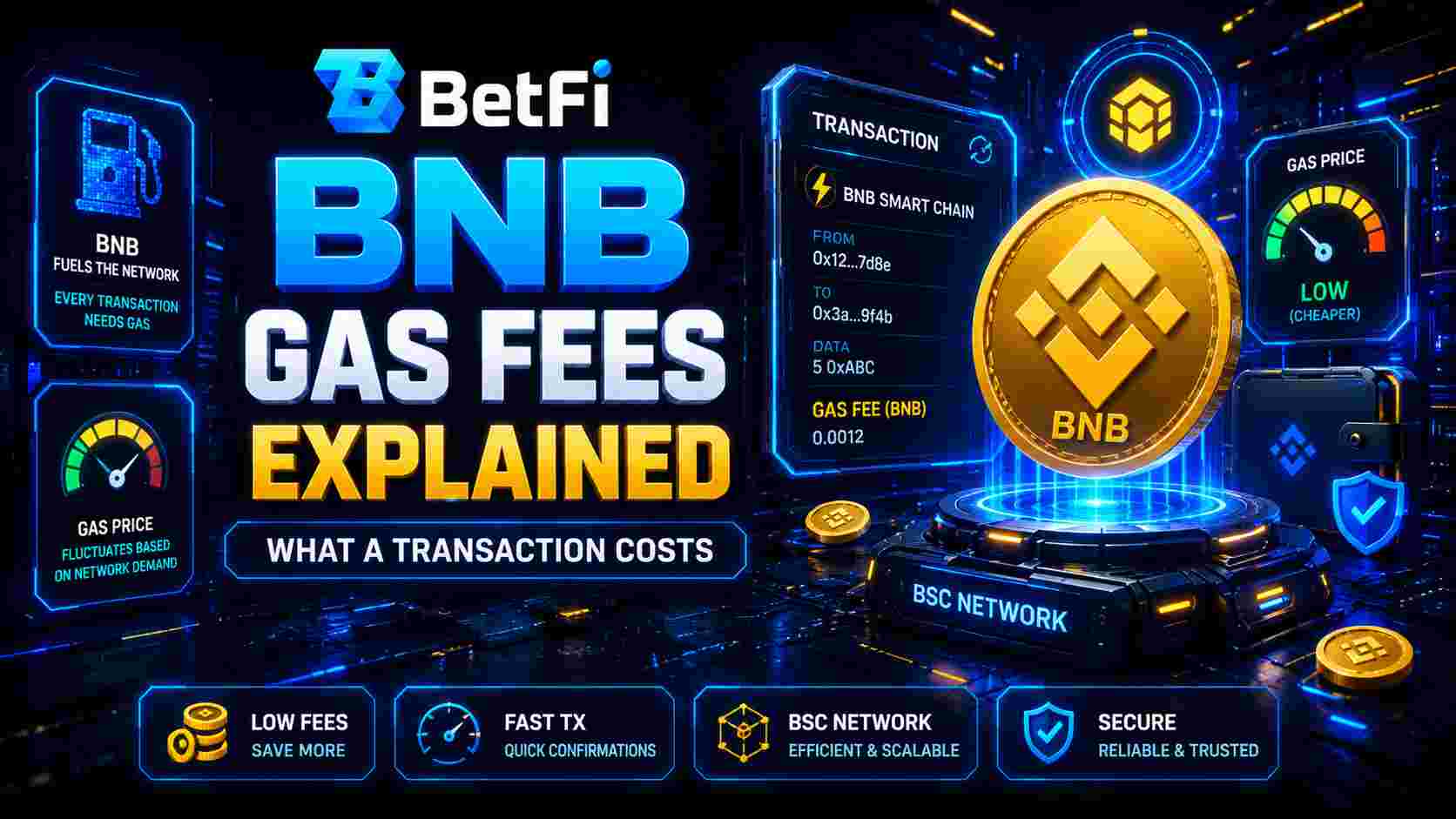
Every transaction on BNB Chain requires BNB to pay gas, including transactions that move a completely different token. Gas limit is how much computational work your transaction needs; gas price is what you pay per unit of it. Failed transactions still consume gas, which is why lowering the gas limit to save money never works. Keeping roughly $2–3 of BNB in any BNB Chain wallet prevents most failures.
Major Points Covered
- Gas limit and gas price are separate numbers that fail in different ways.
- You need BNB to move BSC-USD, because the network charges in its own currency.
- Typical costs by transaction type, from a simple transfer to a decentralised exchange swap.
- Approvals are a separate transaction, which is why a first swap costs roughly double.
- BscScan shows the revert reason on any failed transaction.
Direct Answers to Common Questions
BNB gas fees are paid in BNB because BNB is the native currency of BNB Smart Chain, and the network charges for computation in its own currency regardless of which token your transaction moves. A simple BEP-20 transfer typically costs $0.15 to $0.25, while a decentralised exchange swap runs roughly $0.40 to $0.80. The total is gas limit multiplied by gas price, where the limit is set by what the transaction does and the price is set by network demand. Keep roughly $2–3 of BNB in any wallet you use, or transactions will fail even with a healthy stablecoin balance.
Understanding What Gas Actually Pays For
Every transaction consumes computational work from the network's validators. Gas is the unit measuring that work, and the fee is what you pay validators to perform it.
The mechanism exists for a practical reason. Without a cost per operation, anyone could flood the network with meaningless transactions. Gas prices computation, which makes spam expensive and keeps blocks available for real activity.
Importantly, gas goes to validators — not to any platform or application you happen to be using.
Gas Limit vs Gas Price
Two separate numbers that get conflated constantly.
Gas limit is how much work your transaction needs, determined by what you are doing. A simple token transfer needs little; a multi-step contract interaction needs considerably more. Your wallet estimates this automatically and is usually accurate.
Gas price is what you pay per unit of that work, denominated in gwei, which is one billionth of a BNB. It is set by network demand and by your own willingness to pay for faster inclusion.
Total fee = gas limit × gas price
The distinction matters for troubleshooting. Gas price too low means your transaction waits. Gas limit too low means it runs out mid-execution, fails, and still consumes the gas it used. Failed transactions are not free.
Why You Need BNB to Spend BSC-USD
BSC-USD is a token that lives on BNB Smart Chain. BNB is BNB Smart Chain's native currency. Tokens are entries in a contract, and the network updating those entries charges in its own currency.
The analogy holds up: the tokens are the parcel, BNB is the postage. You cannot pay postage with the contents of the parcel.
Practical rule: keep roughly $2–3 worth of BNB in any wallet you use on BNB Chain. That covers dozens of transactions and prevents the situation where you hold value you cannot move.
Typical Costs by Transaction Type
- Send BNB — Gas used: 21,000; Typical cost: around $0.10
- Send a BEP-20 token — Gas used: 50,000–65,000; Typical cost: around $0.15–0.25
- Token approval — Gas used: around 45,000; Typical cost: around $0.15
- Decentralised exchange swap — Gas used: 150,000–250,000; Typical cost: around $0.40–0.80
- Stake or claim rewards — Gas used: 100,000–200,000; Typical cost: around $0.30–0.70
Figures vary with BNB price and network congestion. Treat them as ranges and confirm current rates before relying on them.

For context, the same operations on Ethereum frequently cost 20 to 100 times more. That difference is precisely why reward tokens expecting holders to claim regularly tend to launch on chains like this one.
Why Approvals Cost Extra
When you first interact with a contract using a token, you must approve that contract to spend it. This is a separate transaction with its own gas cost, which is why a first swap costs roughly double a subsequent one.
Some wallets default to unlimited approval. That is convenient, and it also means the contract retains permanent spending permission. For contracts you use often it is a reasonable tradeoff. For a one-off, set a specific amount instead, and periodically review your active approvals with a revoke tool.
Estimating a Month of Gas Costs
A short exercise worth doing before deciding how actively to manage a position.
Suppose you claim rewards weekly, make two swaps a month and send one transfer. That is roughly eight transactions, landing somewhere near two to four dollars a month on BNB Chain.
The same pattern on Ethereum, at typical rates, would run somewhere between fifty and two hundred dollars. For a large position that is noise. For a position of a few hundred dollars it is the difference between a working strategy and one that quietly loses money to overheads.
The practical implication: decide your claim frequency based on position size. Weekly claims make sense on a large balance, monthly or quarterly on a small one, and the rewards keep accruing either way.
A Few Tips for Avoiding Overpayment
- Accept your wallet's estimate in normal conditions. It reads live network data and is well calibrated.
- Do not raise gas price out of impatience. Blocks arrive roughly every three seconds, so a standard-priced transaction rarely waits long.
- Batch where you can. Claiming rewards weekly instead of daily is six fewer transactions.
- Avoid peak congestion if you are flexible. Large launches push prices up temporarily.
- Never lower the gas limit to save money. A failed transaction costs gas and delivers nothing.
Reading a Transaction on BscScan
Every BNB Chain transaction is public. Paste your transaction hash into BscScan and you will see the status, the gas limit and usage, the transaction fee you actually paid, and the tokens transferred.
If a transaction failed, BscScan usually displays a revert reason at the top. That text is the fastest route to diagnosing the problem, far quicker than guessing from your wallet's generic error message.
Common Gas Problems
- "Insufficient funds for gas" — no BNB in the wallet. Send a small amount and retry.
- Transaction pending indefinitely — gas price below the current network rate. Most wallets offer a speed-up option.
- "Out of gas" failure — gas limit too low. Retry with the wallet's suggested limit.
- Fee higher than expected — usually an approval bundled with the main transaction, or genuine congestion.
Why This Shapes Chain Selection
Gas costs are not a detail for a reward token. BFC rewards are designed to be claimed regularly, and on a chain where each claim cost several dollars the mechanic would be unusable for smaller holders. That is the practical reason BetFi is built on BNB Smart Chain rather than on a more expensive network.
Keep $2–3 of BNB in the wallet. That single habit prevents the majority of failed transactions.
Frequently Asked Questions
Why do I need BNB if I only hold BSC-USD?
Because BNB is the native currency of BNB Smart Chain, and the network charges for computation in its own currency. Tokens are entries in a contract; BNB pays for updating them.
What is the difference between gas limit and gas price?
Gas limit is how much computational work your transaction needs. Gas price is what you pay per unit of that work. Multiply them together for the total fee.
Do failed transactions still cost money?
Yes. A transaction that runs out of gas mid-execution reverts but still consumes the gas it used. This is why lowering the gas limit to save money is a false economy.
How much BNB should I keep for gas?
Roughly $2–3 covers dozens of transactions on BNB Chain. Keeping that float permanently prevents the most common cause of failed transactions.
Why did my first swap cost double?
Because it included a separate approval transaction granting the contract permission to spend your token. Subsequent swaps with the same contract do not repeat that step.