

RTP Explained: What Return to Player Really Means
August 5, 2026

RTP, or Return to Player, is the percentage of all money wagered that a game returns to players as a group across its full modelled lifetime. It is not a forecast of your session. The edge applies to turnover rather than deposits, so every re-staked win is counted again. Two games at identical RTP can feel completely different depending on variance, which is why variance is the more useful number when you are choosing what to play tonight.
Major Points Covered
- RTP describes the game's design across millions of rounds, not your evening.
- The house edge applies to turnover, so re-staking a win costs you again.
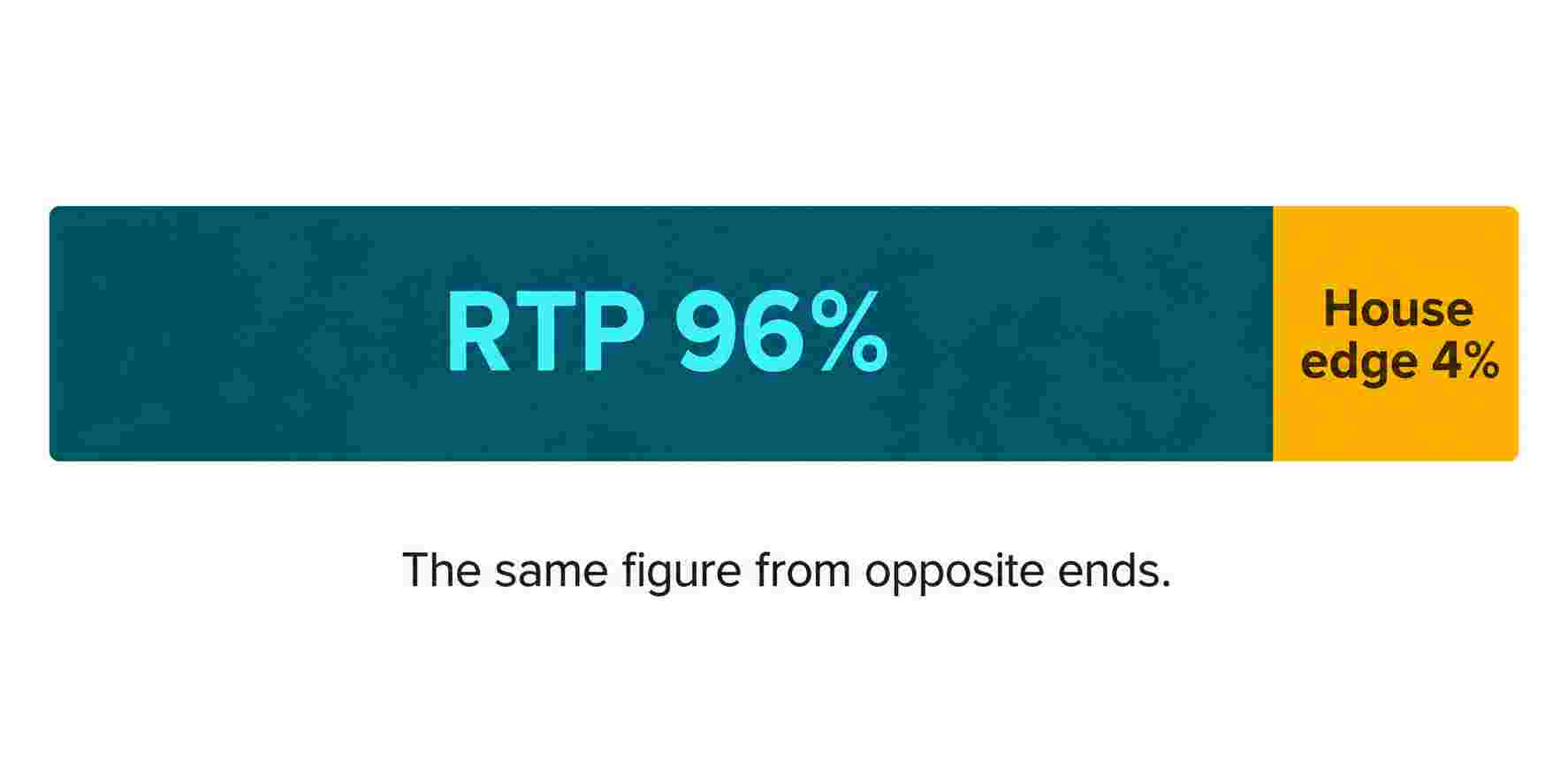
- House edge and RTP are the same figure inverted, and should sum to 100%.
- Variance affects a single session far more than RTP does.
- Provable fairness verifies individual outcomes, not the RTP figure itself.
Direct Answers to Common Questions
RTP means Return to Player, and it measures the percentage of all wagers a game returns to its players collectively over its full modelled lifetime, typically hundreds of millions of simulated rounds. A 96% RTP game does not return 96% of your deposit. Because the figure applies to total amount wagered rather than to money deposited, and because every winning payout you re-stake counts again toward that total, playing a fixed stake long enough drives the expected end point toward zero rather than toward 96%. RTP is a specification of how the game was built, not a prediction of what tonight will do.
Understanding What the Number Measures
Every clause in the definition is load-bearing.
All money wagered, not money deposited. Every time you re-stake a win, that stake counts again toward the total.
Players as a group, not you individually. The figure describes the aggregate, which includes the person who hit the jackpot and the hundred people who did not.
Full modelled lifetime, typically hundreds of millions of simulated rounds, far beyond any individual's experience.
The Turnover Point, Illustrated
Deposit £100 on a 96% RTP game and play through it repeatedly. Your first £100 of wagers returns roughly £96. Re-stake that £96 and it returns roughly £92. Continue and the balance grinds down, because the edge applies to turnover.
Play long enough at a fixed stake and the expected end point approaches zero, not 96%. That is not a trick, it is arithmetic, and it is the single most useful thing to understand about casino games.
RTP and House Edge Are the Same Figure
House edge is simply the remainder. A 96% RTP game carries a 4% house edge, and any game quoting both should have them sum to 100%.
Here is how the common games compare:
- Blackjack, optimal strategy — RTP: \~99.5%; House edge: \~0.5%
- Baccarat, banker bet — RTP: \~98.9%; House edge: \~1.1%
- European roulette — RTP: \~97.3%; House edge: \~2.7%
- American roulette — RTP: \~94.7%; House edge: \~5.3%
- Video slots — RTP: 94–97%; House edge: 3–6%
- Keno — RTP: 75–90%; House edge: 10–25%
Figures are approximate and vary by rule variant and operator. Blackjack's 99.5% assumes optimal play on every hand; played casually the effective RTP drops substantially, often below a decent slot. Always confirm in the game's info panel.
The Timescale Problem
RTP converges over a sample size no individual will ever produce. Across ten thousand spins, already far more than a typical month, results still scatter widely around the modelled figure. Across a hundred spins it tells you almost nothing.
This cuts both ways, and the upside deserves stating: short-run variance is also why players win. If results converged quickly, nobody would ever finish a session ahead. The gap between the model and the evening is the entire reason the games are entertaining.
Why Variance Matters More Than RTP
Two games can share an identical 96% RTP and feel completely different.
Low variance delivers frequent small wins. Your balance drifts rather than lurching, and sessions last longer on the same bankroll.
High variance delivers long dry stretches punctuated by occasional large payouts. The same bankroll disappears far faster, or occasionally multiplies.
Same expected return, radically different distribution. If you are choosing a game to play for two hours on a fixed budget, variance is the more relevant number. Most providers publish a volatility rating alongside RTP.
What RTP Does Not Tell You
Four things the number is silent on, each of which affects your experience more than the headline percentage.
- Hit frequency — how often any win lands, regardless of size. A game can pay on one spin in three or one in eight at identical RTP.
- Maximum win — two 96% games can cap at 500× and 50,000×, which entirely changes the distribution.
- Bonus round contribution — on many slots a large share of total RTP sits inside a feature that triggers rarely, so base-game play returns far less than the headline.
- Bet-level dependency — some games alter effective RTP by stake level or optional bet features.
How Provably Fair Systems Fit In
On a provably fair game, each round's outcome derives from a server seed, a client seed and a nonce. After the round the server seed is revealed and you can recompute the result yourself.
Be precise about what this proves. Provable fairness verifies that individual outcomes were not tampered with. It does not independently verify the RTP figure, which comes from the game provider's certification, ideally tested by an accredited laboratory such as eCOGRA. Both matter, and they are different guarantees.
The Configurable RTP Problem
A detail most players never encounter: many slot providers ship the same game in multiple RTP configurations, and the operator chooses which to deploy. The same title might run at 96.5% on one site and 94% on another, with identical artwork.
Check the RTP on the game's own info panel rather than relying on figures quoted elsewhere. If an operator does not display it in-game, that omission is itself informative.
A Few Tips for Playing
- Read the volatility rating, not just the RTP. It tells you what the session will feel like.
- Check RTP in the game's info panel, since the same title can run at different rates on different sites.
- Prefer lower house-edge games if longevity matters. Moving from 5.3% to 2.7% halves your expected cost per unit wagered.
- Set a turnover budget, not just a deposit budget. The edge charges you for playtime, not for deposits.
How BetFi Approaches This
You cannot change a game's RTP, but rakeback measurably offsets it. A percentage returned on every wager regardless of outcome directly reduces the effective edge. On a 96% RTP slot carrying a 4% edge, a 3% rakeback brings the effective edge down to roughly 1%.
That does not make the game profitable, since the edge is still against you. It does materially slow the rate at which a bankroll depletes, and it is the one mechanic on this page that changes the maths in your favour.

Frequently Asked Questions
What does RTP mean in casino games?
RTP means Return to Player: the percentage of all wagers a game returns to players collectively across its full modelled lifetime. It describes the game's design, not your session.
Does 96% RTP mean I get 96% of my money back?
No. The figure applies to total amount wagered, not to deposits, and every re-staked win counts again. Playing a fixed stake long enough drives the expected end point toward zero.
Is RTP or variance more important?
Variance, for a single session. Two games at identical RTP can behave completely differently, and volatility determines whether your bankroll drifts or lurches.
Can casinos change a game's RTP?
Providers often ship the same game in multiple RTP configurations and the operator chooses which to deploy. Always check the figure in the game's own info panel.
Does provably fair prove the RTP is correct?
No. It proves an individual round's outcome was not altered after your bet. The RTP figure comes from the provider's certification, ideally tested by an accredited laboratory.